



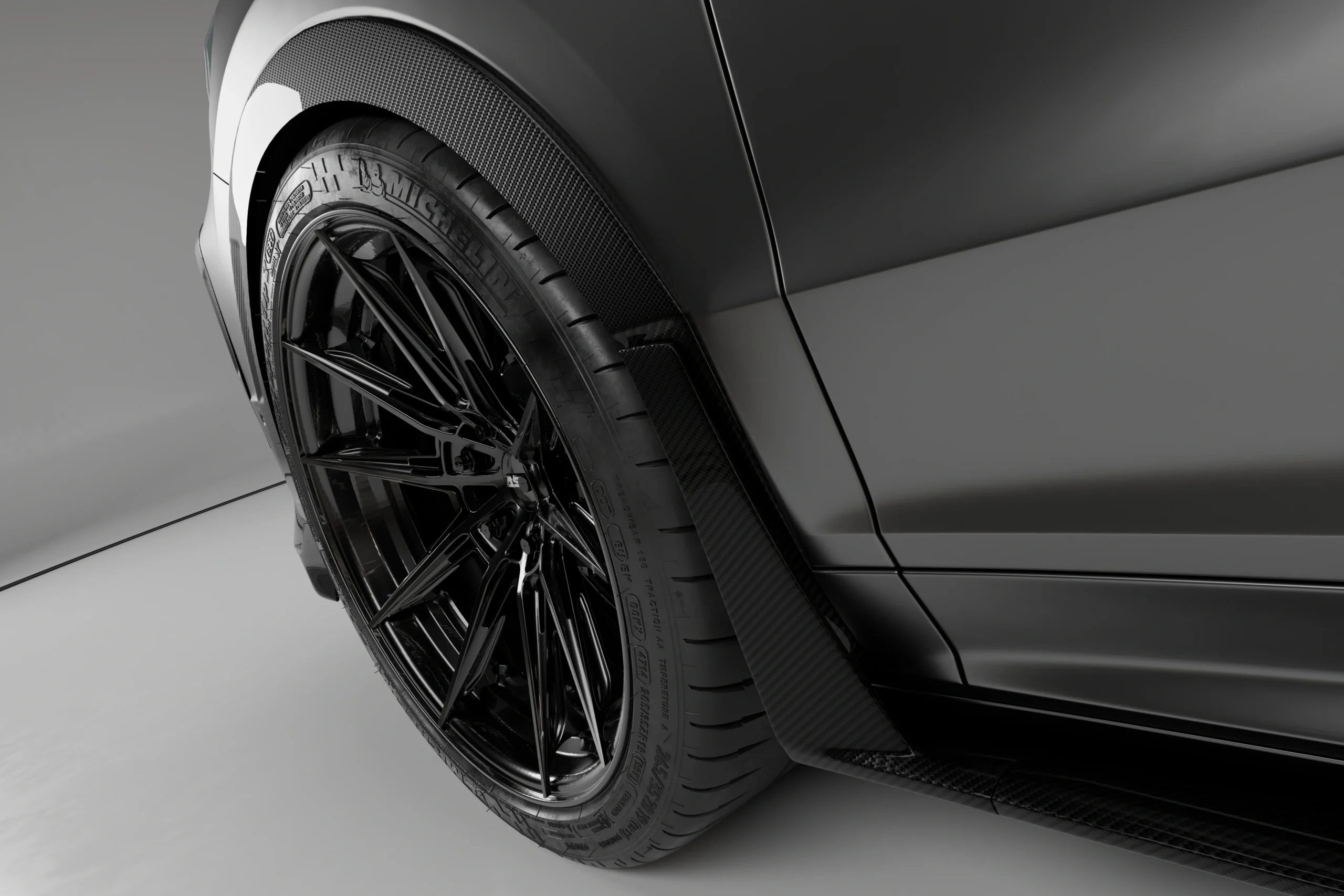
Bigger wheels. Same car underneath. That's the whole art.
Every platform has a wheel setup that transforms how it looks — and a setup one step past it that ruins how it drives. This guide is about finding the first and never crossing into the second: the sidewall rule, what diameter, width and offset actually change, and why construction decides how far you can go.
- The sidewall is part of your suspension. Go up in rim diameter and the tyre's sidewall shrinks to keep the same rolling diameter — every millimetre you give up is compliance your road surface will invoice you for.
- The right size is a ceiling, not a target. The best-looking setup is the largest wheel that keeps enough sidewall for the roads you actually drive — not the largest wheel that physically fits.
- Construction buys back the compromise. A forged wheel is significantly lighter than a cast wheel of the same size — less unsprung mass returns ride quality and response that bigger diameters take away.
The one rule that governs everything
Your car's overall tyre diameter is essentially fixed — change it meaningfully and the speedometer, gearing and driver aids all read the world wrong. So when you go up a rim size, the tyre doesn't get taller; the sidewall gets shorter to keep the same rolling diameter.
That sidewall is your suspension's first spring. It absorbs the sharp edges — expansion joints, drain covers, the pothole you never saw — before the dampers are even asked. Shrink it and three things happen at once: the ride hardens, the wheel becomes easier to crack or buckle on impact, and the steering gains sharpness because there's less rubber flexing between your hands and the road.
"Nobody ever ruined a car by choosing one inch less than the maximum. Plenty have ruined one by choosing one inch more."
See the trade
Drag the slider. The rolling diameter stays constant — watch what larger rims actually spend.
Balanced territory — strong stance with enough sidewall to work. Where most street builds should live.
Diameter, width, offset — what each actually changes
Three numbers define a wheel. Each buys something and each has a bill:
Cast vs flow-formed vs forged
Same size, same photo — three different objects. Construction is where ride quality is won back:
The entry point.
- Molten alloy poured into a mould — simple and cheap to make.
- Needs more material for strength, so it carries the most weight.
- Tends to crack rather than bend under hard impact.
- Fine for modest sizes; punishing at large diameters.
The middle path.
- Cast centre with a barrel stretched under rollers — stronger, lighter than pure cast.
- A genuine step up, and honest value at its price.
- Still limited by the cast centre's material needs.
- Good; not the ceiling.
The reason big wheels can ride well.
- Machined from a single forged billet — the densest, strongest grain structure.
- Strength from the material, not from mass: significantly lighter at any size.
- Less unsprung and rotational mass — better ride, sharper response, easier on suspension.
- The construction that lets you take the diameter without paying the full bill.
This is the honest resolution of the whole article: the size you want and the ride you want stop being enemies when the wheel stops being heavy. Forged construction doesn't make physics disappear — it moves the ceiling.
Fitment without regret
The difference between a setup that looks commissioned and one that looks forced is fitment discipline:
Platform-specific spec. Offset, width and clearances calculated for your exact car — brakes, suspension, arch liners — not a "fits most" range.
Respect the rolling diameter. Tyre size chosen so the overall diameter stays within a whisker of factory — speedo, gearing and driver aids stay honest.
Flush, not poked. The face sitting level with the arch reads engineered; past it reads improvised and eats arch liners on compression.
Staggered where the platform wants it. Rear-driven performance cars often run wider rears by design — follow the platform's logic, don't fight it.
Load rating in writing. Confirmed for your car's corner weights — especially on heavy, fast platforms.
Tyres budgeted with the wheels. A serious wheel on a compromised tyre is a contradiction — spec them as one decision.
Find your direction
Two honest questions — the readout gives the guidance we'd give in a consultation.
Specified to the platform. Forged to forget the compromise.
ASM forged wheels are machined from single forged billets and specified to your exact platform — diameter, width, offset and load rating calculated as one decision, with the tyre. The result is the setup this whole article describes: the presence you wanted, without the ride you feared.
Every specification is confirmed in consultation before production — sizes, clearances, and how the wheels sit with the aero programme.
The fine print, answered plainly.
Do bigger wheels always ruin ride quality?
Not always — but every inch of diameter costs sidewall, and sidewall is compliance. The setups that stay comfortable pair a sensible diameter for the owner's roads with light, forged construction, and keep the overall rolling diameter at factory. It's the combination that decides, not the diameter alone.
What does wheel offset actually do?
Offset sets where the wheel sits in the arch. Lower offset pushes the face outward toward flush; too low causes arch contact and loads the bearings. It's calculated per platform against brakes, suspension and arch clearance — the number to get right, not to guess.
Why are forged wheels so much more expensive than cast?
The process — machining from a single forged billet — produces a denser, stronger structure that needs far less material. You're paying for strength without mass: less unsprung weight, better ride, sharper response, and greater impact resistance at any given size.
Should I run a staggered setup?
If your platform was designed for it — most rear-driven performance cars run wider rears from the factory — then a staggered specification follows the car's own logic. The key is doing it to a calculated spec, keeping front and rear rolling diameters compatible with the driveline and its systems.
Do I need to change tyres when I change wheel size?
Almost always — the tyre's profile must shrink as the rim grows so the overall diameter stays near factory. Specify wheels and tyres as one decision; a serious wheel on the wrong tyre undoes the point of both.
This guide is general information, not a substitute for a platform-specific fitment calculation. Confirm sizes, offsets and load ratings for your exact vehicle before ordering.
The right size exists. Let's calculate it.
Tell us your platform and your roads — we'll spec diameter, width, offset and tyre as one decision.