



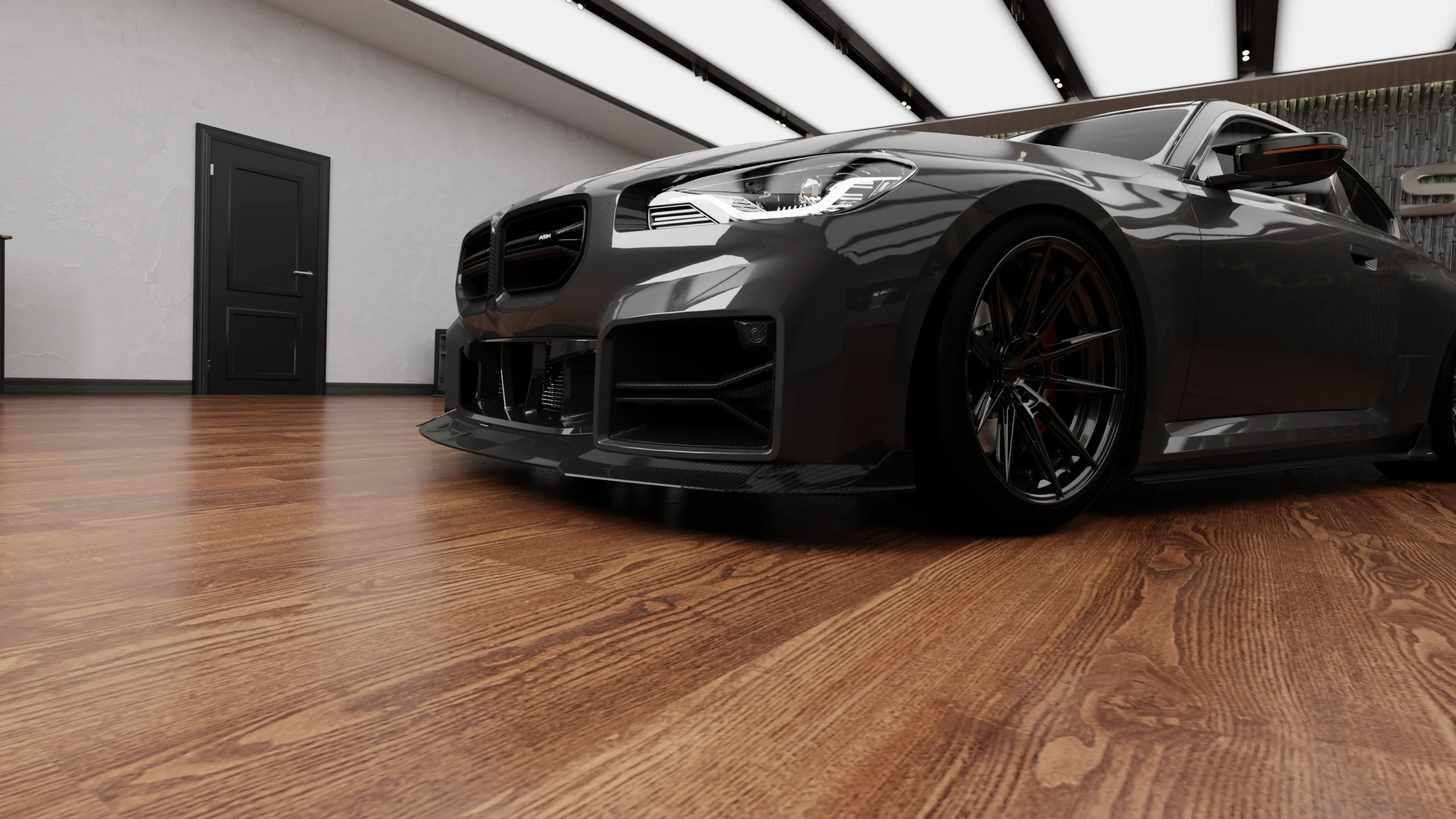
Everything worth knowing before the first panel is ordered.
The G87 M2 is the last of its kind — compact, straight-six, rear-driven — and it rewards carbon aero better than almost anything BMW builds. This guide covers the full landscape: every component, the right build order, the material truth, and the checks that separate an engineered programme from an expensive mistake.
- Buy platform-specific, or don't buy. The G87's front apertures, arch geometry and rear proportions are unique to it — universal-fit panels will never sit right, and everyone who knows the car can tell.
- The material decides how the kit ages. Dry pre-preg, autoclave-cured carbon keeps its shape and weave for years. Wet-layup looks the same for a season, then tells on itself.
- Build in the right order. Front first, rear balance second, detail last. A plan spends the same money and gets a resolved car; impulse gets a collection of parts.
Why the G87 rewards carbon
The G87 M2 carries M3/M4 hardware in a shorter, wider-feeling body — boxed arches, a deep front, a high tail. It's a design with strong bones and unfinished edges: the lower front reads flat from the factory, the flanks are tall, and the rear leaves visual mass sitting above the diffuser line.
That's exactly the profile carbon aero was made for. A splitter gives the front its missing edge and visually drops the nose. Side blades cut the flank height. A diffuser and spoiler pull the tail down and tie the rear together. On a car this compact, each component changes a large share of what you see — which is why the G87 transforms harder per part than bigger platforms do.
"The G87 doesn't need to be changed. It needs to be finished — and the factory left exactly the right edges open for it."
The component map, zone by zone
Select a zone of the car — each panel is listed with what it actually does, so you're buying function, not decoration.
Pre-preg vs wet-layup — the real difference
Two parts can look identical in a product photo and be different objects entirely. This is the comparison that decides how your kit looks in year three:
Looks the part. For a while.
- Resin applied by hand — heavier, with inconsistent saturation.
- Cured at ambient conditions; shape stability depends on luck.
- Prone to warping in heat, weave distortion and clear-coat crazing.
- Cheap to make — which is the entire reason it exists.
The material the look is borrowed from.
- Resin pre-impregnated into the weave at controlled ratios.
- Autoclave-cured under heat and pressure — the F1 and hypercar process.
- Lighter, stiffer, with a tight, symmetrical weave that stays put.
- Holds its shape, finish and mounting geometry for the life of the car.
On a car parked in sun, driven hard and photographed constantly, the difference isn't subtle — it's the difference between a build that still looks commissioned in three years and one that quietly starts apologising.
The right build order
If the programme happens in stages, sequence matters — the same money spent in the right order gives you a resolved car at every step, never an awkward in-between:
Or commission the full programme at once — one production run, one paint-and-fit appointment, one finished car. The staged route exists for pacing the spend, not because it's better.
Seven checks before you buy anything
Run every kit you're considering — ours included — through this list. A supplier who passes all seven is selling you an engineered part; anyone who fails two or more is selling you a photo:
Platform-specific mould. Made for the G87 specifically — not "fits M2/M3/M4" universal geometry. Ask directly.
Stated construction. "Carbon fibre" alone is not an answer. Dry pre-preg, autoclave-cured — in writing.
Test-fitting before dispatch. A part checked against the platform before it ships is a part that fits when it arrives.
OEM mounting points. Bolt-on to factory locations — no drilling improvisation, fully reversible, warranty-clean.
Real product photography. The actual part on the actual car — not renders. Renders hide what moulds reveal.
Documentation with the part. Invoices and specification you can hand an insurer today and a buyer in three years.
A human you can talk to. Fitment questions answered before the order, by the people who made the part — not a ticket queue.
Plan your G87 build
Choose the direction and the pace — the planner assembles the specification the way we would in a consultation.
Every check on that list — by design.
ASM carbon for the G87 M2 is moulded to the platform, produced in dry pre-preg carbon, autoclave-cured, test-fitted before dispatch and mounted to factory points — supplied with full documentation, and a direct line to the team that built it.
Not because a checklist says so. Because that's what building it properly means.
The fine print, answered plainly.
What's the best first carbon part for a G87 M2?
The front splitter. It delivers the largest visual change on the car, anchors every panel that follows, and gives the deep G87 front its missing leading edge. Splitter first, diffuser second is the sequence that keeps the car resolved at every stage.
Is pre-preg carbon worth the extra cost over cheaper kits?
If you keep the car more than a season, yes. Pre-preg holds its shape, weave and finish for years; wet-layup panels commonly warp in heat and craze over time. The cost difference buys the part's future, not its first photo.
Will carbon aero fit over factory G87 parts, or do things get removed?
Properly engineered components mount to factory points — typically over or in place of trim pieces — with no drilling or permanent change. That keeps the car reversible, which matters for warranty, lease returns and resale.
Should I buy a full kit or build in stages?
Both work — the difference is pacing, not outcome. A full programme means one production run and one finished car. Staged builds should follow the order in this guide (splitter → diffuser → skirts → details) so the car looks intentional at every step.
Does carbon aero affect the G87's warranty or insurance?
Bolt-on aero doesn't void a manufacturer warranty — a claim can only be declined where a modification caused that specific fault. Insurance requires the modification to be declared, which for aero carbon is usually straightforward. We've covered both in detail in our insurance and warranty guide.
This guide is general information for G87 M2 owners, not legal or financial advice. Confirm fitment details for your exact production year before ordering.
The last M2 of its kind deserves better than parts.
Talk your G87 through with us — direction, sequence, lead times — before anything is ordered.