



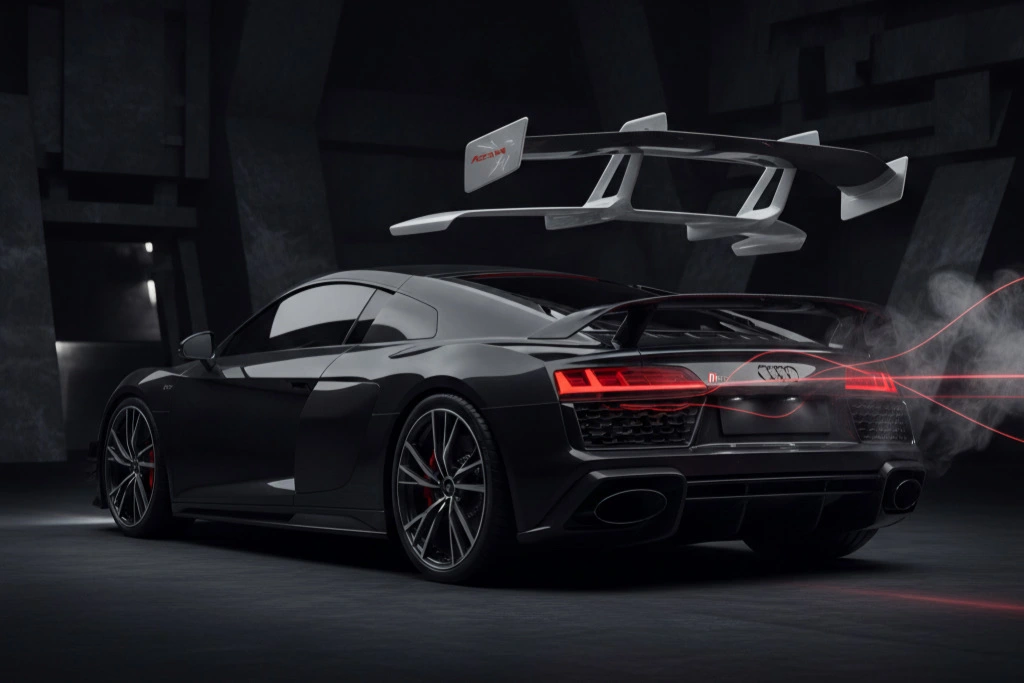
Spoilers vs GT Wings: Choosing the Right Rear Downforce Solution
Rear aero is not simply about adding something aggressive to the back of a car. A spoiler and a GT wing are two very different aerodynamic tools, built for different speeds, different driving environments and different levels of vehicle direction.
It is not which one looks faster. It is which one belongs on the car.
The difference between a spoiler and a GT wing is one of the most misunderstood areas in vehicle aerodynamics. Many people group both components together because they sit at the rear of the vehicle. In reality, they influence airflow in different ways.
A rear spoiler is usually designed to manage separation, reduce lift and clean the airflow leaving the body. A GT wing is an independent aerodynamic surface designed to generate measurable downforce by using pressure difference above and below the wing profile.
For a road-focused performance build, the best answer is not always the largest component. The right solution depends on platform, speed range, suspension setup, tyre capability, front aero balance and how the car is actually driven.
A complete-build philosophy looks at the car as a system. Rear downforce only works properly when it is matched to the front of the car and integrated with the full aerodynamic direction.
How rear aero changes the way air leaves the car
A spoiler works with the shape of the vehicle body. It interrupts, redirects or stabilises airflow as it separates from the rear surface. A GT wing works more like an inverted aircraft wing, creating a pressure difference that pushes the rear axle into the road. Both can be valuable, but they are not interchangeable.
Spoiler vs GT wing: the technical distinction
Subtle airflow management
A spoiler is typically mounted close to the boot lid, tailgate or rear deck. Its purpose is to influence the airflow coming off the body of the car. On many vehicles, air leaving the rear can create lift, turbulence or instability. A correctly designed spoiler helps reduce that effect.
For road performance cars, this is often the most balanced solution. It can improve high-speed confidence without excessive drag, visual disruption or unnecessary track-focused aggression.
Independent downforce generation
A GT wing sits higher in cleaner airflow. It is designed to actively generate downforce by creating higher pressure above the wing and lower pressure below it. This can increase rear grip at speed, particularly on track where cornering loads are higher.
However, a GT wing can also add drag, alter balance and create rear-biased grip if the front aero is not developed to match it. Used incorrectly, it can make a car feel stable at the rear but lighter at the front.
Which rear aero solution fits your build?
| Factor | Rear Spoiler | GT Wing |
|---|---|---|
| Primary function | Reduces rear lift, manages airflow separation and improves stability. | Generates measurable rear downforce through an independent aerodynamic profile. |
| Best use case | Road-focused performance builds, OEM+ vehicle direction and refined aero upgrades. | Track-focused vehicles, high-speed cornering environments and motorsport-inspired setups. |
| Drag impact | Usually lower when correctly designed and integrated. | Often higher, especially with aggressive angle of attack or large surface area. |
| Visual impact | Subtle, integrated and factory-inspired. | More dramatic, technical and motorsport-led. |
| Balance requirement | Works well as part of a balanced street aero package. | Requires stronger front aero consideration to avoid rear-heavy aerodynamic balance. |
| ASM perspective | Ideal for refined performance and complete-build integration. | Correct only when the full platform direction supports it. |
Rear downforce is only useful when the whole car remains balanced
More rear grip is not automatically better. If the rear of the car gains downforce but the front remains unchanged, the aerodynamic centre of pressure can move rearward. This may make the car feel planted in a straight line, but it can reduce front-end confidence during high-speed direction changes.
This is why rear aero should never be selected in isolation. A spoiler, diffuser, front splitter, side skirt and wheel setup all influence the way air moves around the vehicle. The goal is not to add separate parts. The goal is engineered integration.
For road cars, refinement usually wins. For track cars, function becomes more aggressive.
On a road-focused build, a well-designed carbon fibre rear spoiler often delivers the most appropriate balance of visual presence, stability and usability. It supports the original design language of the car while adding a more controlled rear profile.
A GT wing belongs in a different category. It becomes more relevant when a car is driven at speeds and cornering loads where measurable downforce can be used consistently. That usually means track days, time attack builds or highly developed performance platforms.
The key is honesty about the vehicle’s purpose. A daily driven performance car does not always need track-level rear aero. A serious circuit build should not rely on cosmetic aero language. Each direction has its own engineering logic.
ASM direction
ASM Sports Tech favours platform-focused development. That means every component should feel like it belongs on the car — visually, mechanically and aerodynamically.
A rear spoiler is not “less serious” than a wing. On the right vehicle, it is the more refined and more intelligent solution.
Choose a spoiler if your priority is integrated performance
Refined rear stability
A spoiler suits drivers who want improved rear confidence without changing the entire character of the car. It can sharpen the rear profile, reduce unwanted lift and maintain a clean factory-inspired silhouette.
Works with splitters, skirts and diffusers
On a complete carbon fibre aero package, the rear spoiler becomes part of the whole composition. It supports the front splitter, side extensions and diffuser without overpowering the build.
Choose a GT wing only when the platform can support it
Higher rear load potential
A GT wing can create stronger rear downforce, especially at higher speeds. This can improve rear grip through fast corners, but the benefit only becomes meaningful when the car’s tyres, suspension and front aero can use that extra load.
Front aero must match
A large rear wing without sufficient front aero can create imbalance. The car may become more secure at the rear while losing front-end authority. This is why proper aerodynamic development treats the vehicle as one complete system.
Performance without compromise is not about maximum aggression. It is about correct integration.
At ASM Sports Tech, the focus is not simply to make a vehicle look modified. The aim is to create a defined vehicle direction: aerodynamic balance, OEM+ fitment, material quality and a complete-build philosophy that feels intentional from every angle.
For platforms such as the BMW G87 M2 and BMW G82 M4, rear aero has to respect the proportions of the car. A spoiler can add precision and confidence while preserving the original design architecture. A wing can be valid, but only when the full programme is developed around that intent.
This is the difference between adding parts and building a complete performance identity.
Spoiler vs GT wing questions
Is a spoiler the same as a wing?
No. A spoiler usually works with the vehicle body to manage airflow separation and reduce lift. A wing is an independent aerodynamic surface designed to generate downforce through pressure difference.
Does a rear spoiler create downforce?
Some spoilers can contribute to rear stability and lift reduction, but most road spoilers are not designed to generate the same level of downforce as a proper GT wing. Their main value is controlled airflow and improved rear-end confidence.
Is a GT wing better than a spoiler?
Not always. A GT wing can be better for track-focused cars that need stronger rear downforce. For road-focused builds, a spoiler is often the more refined and balanced solution.
Can a wing make a car slower?
Yes. A wing can add drag, especially if it is too large, poorly positioned or set at an aggressive angle. If the car cannot use the extra downforce, the result can be more resistance without meaningful performance benefit.
What is best for an OEM+ performance build?
For most OEM+ builds, a well-integrated carbon fibre rear spoiler is the better choice. It supports the car’s original design language while adding rear stability and a more complete performance presence.
Should rear aero be matched with front aero?
Yes. Rear aero should always be considered with front splitter design, diffuser behaviour, side skirt airflow and overall vehicle balance. A complete aero setup performs better than isolated components.
Rear aero is one decision. The complete vehicle direction is the real performance statement.
Explore ASM Sports Tech aerodynamic programmes developed around refined performance, OEM+ fitment and complete-build integration.