



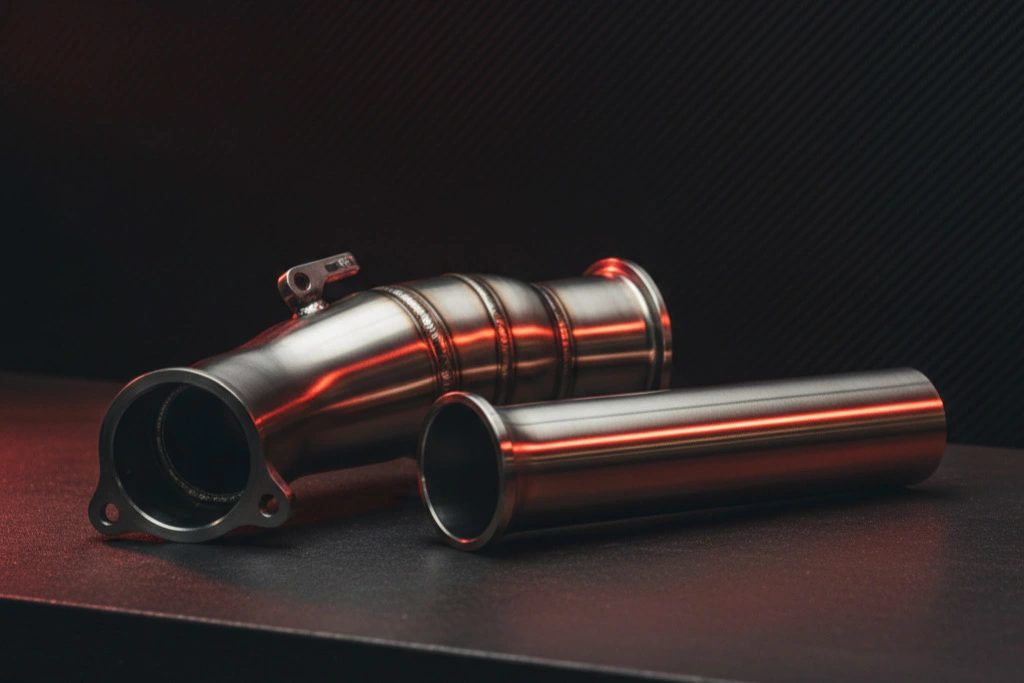
Downpipes Explained: What They Do and Why You Might Need One.
A downpipe is one of the most important upgrades on a turbocharged performance car — but it is also one of the most misunderstood. This guide explains how a downpipe works, the difference between sports cat and decat setups, what changes in sound and response, and how to choose the right specification without building the car in the wrong direction.
What does a downpipe actually do?
A downpipe is the section of exhaust that connects directly after the turbocharger and carries exhaust gases away from the turbine housing. On a turbocharged car, this area is critical because the turbo relies on exhaust gas movement to operate efficiently. If the exhaust path after the turbo is restrictive, hot gases leave less freely, back pressure increases, and the turbo may not respond as sharply as it could.
Factory downpipes are usually designed around emissions, noise control, warranty expectations, packaging, cost and refinement. That does not mean they are poorly engineered; it means they are engineered for a different compromise. A performance downpipe is designed to improve exhaust flow, support stronger turbo response and create a more defined exhaust character.
For many cars, especially tuned BMW, Audi, Mercedes-AMG, VW, Porsche and other turbocharged performance platforms, the downpipe becomes one of the first serious hardware upgrades because it changes how the engine breathes under load.
Engine Load
The engine produces exhaust gas as boost and combustion increase under acceleration.
Turbocharger
Exhaust energy drives the turbine, helping the turbo produce boost pressure.
Downpipe
The downpipe controls how freely exhaust gases leave the turbocharger area.
Catalyst
A sports cat retains a catalytic core, while a decat removes that restriction entirely.
Exhaust Tone
Flow, catalyst type and system layout shape volume, smell, tone and daily usability.
Test which downpipe direction fits your build.
A downpipe is not a one-size-fits-all upgrade. A daily-driven road car, a weekend performance build, a show car and a track-focused project all need different decisions. Use the ASM downpipe direction simulator to understand the route that fits your build before choosing parts.
Downpipe Direction Simulator
Select your vehicle use and your main goal. The recommendation updates instantly.
For a road car, a sports cat downpipe is usually the more complete route. It improves flow and response while keeping a catalyst in the system and preserving better daily usability.
The difference between a sports cat and a decat.
Road-focused performance with a catalyst retained.
A sports cat keeps a catalytic converter in the system while improving flow compared with a restrictive factory setup. It is the more sensible direction for road-focused builds where usability, smell, MOT considerations and ownership confidence matter.
Maximum flow for track-focused use.
A decat removes the catalytic converter completely. This can reduce restriction and increase volume, but it brings major road-use, emissions, smell, MOT and insurance considerations. It should be treated as a track or off-road specification.
The best setup depends on how the car is used.
A weekend road car, a daily driver and a circuit-only build do not need the same exhaust direction. The right choice balances performance, sound, heat, tuning, emissions and long-term ownership.
Why upgrade your downpipe?
The biggest reason to upgrade a downpipe is not just noise. A properly selected downpipe can support the entire performance direction of the car. It can help the turbo breathe more freely, sharpen response, support stronger tuning results and create a deeper exhaust character.
On a turbocharged platform, flow after the turbo matters. A less restrictive downpipe helps exhaust gases move away from the turbine area more efficiently. This can improve the way the car feels under acceleration, especially when paired with the correct software and supporting hardware.
| Benefit | What it means | Buyer note |
|---|---|---|
| Sharper turbo response | The turbo can feel more eager because gases exit the turbine area more freely. | Most noticeable on tuned turbocharged cars where supporting calibration is used. |
| Stronger sound | The exhaust tone becomes deeper, clearer and more defined under load. | Sports cat keeps the sound more controlled; decat is usually rawer and louder. |
| Power potential | A downpipe can support higher flow and help unlock gains when combined with mapping. | The exact gain depends on vehicle, tune, turbo, fuel, temperature and supporting parts. |
| Better tuning foundation | It gives the engine a stronger exhaust-flow platform for later performance work. | Think of it as part of a system, not an isolated upgrade. |
| More character | The car feels more alive because sound, response and load behaviour become more connected. | This is often why owners feel the upgrade immediately, even before chasing numbers. |
Why the right downpipe choice matters for UK road cars.
For UK road-focused cars, the most responsible direction is usually a high-quality sports cat downpipe. It keeps a catalytic converter in the system while improving flow and sound. That makes it a better ownership route than a decat for most drivers who still use the vehicle on public roads.
A decat setup removes the catalyst completely. Even if the car feels faster or sounds more aggressive, it can create unwanted smell, excess volume, warning lights, emissions concerns and inspection issues. It may suit a controlled track build, but it is not the refined route for most road cars.
ASM Sports Tech recommends thinking beyond the part itself: catalyst type, emissions equipment, exhaust noise, mapping, sensor behaviour, installation quality and insurance disclosure should all be considered before ordering.
| Setup | Best for | ASM view |
|---|---|---|
| Sports cat downpipe | Road-focused performance builds, daily cars, weekend cars and refined tuning setups. | The strongest route for most UK owners because it balances flow, sound and ownership usability. |
| Decat downpipe | Track-focused or off-road projects where road-use requirements are not the priority. | Aggressive and free-flowing, but not the correct road-focused recommendation for most customers. |
| Factory downpipe | Completely standard vehicles where refinement, warranty and emissions compliance are prioritised. | Reliable but often restrictive when the car is tuned for stronger performance. |
A downpipe should not be chosen because it is the loudest option. It should be chosen because it fits the platform, the tune, the road use and the final direction of the build.
ASM Sports Tech — Performance exhaust directionThe mistakes buyers make with downpipes.
Choosing sound before use case.
Loudness feels exciting at first, but it can become frustrating if the car drones, smells, attracts unwanted attention or becomes difficult to live with.
Ignoring software requirements.
Many turbocharged cars need calibration support after a downpipe upgrade. Without the right software, the result can feel unfinished or trigger warnings.
Buying without checking fitment.
Engine code, year, drivetrain and model variation matter. The right part must match the platform precisely, especially on modern performance cars.
Assuming every sports cat is equal.
Catalyst quality, cell count, material, welding, flange position and sensor placement all affect the final result.
Thinking only about peak power.
The best builds consider response, heat, tone, drivability, inspection, insurance and long-term ownership — not only dyno numbers.
Skipping professional installation.
Exhaust leaks, poor clamp alignment, sensor issues and heat problems can turn a good part into a bad experience.
How ASM Sports Tech helps you choose correctly.
ASM Sports Tech does not treat downpipes as random exhaust parts. The correct downpipe has to fit the full vehicle direction: platform, turbo setup, intended use, sound expectation, road suitability, mapping requirements and the rest of the build.
For many customers, the best first step is a sports cat downpipe because it gives a stronger performance feel without moving the car into an overly raw or difficult ownership category. For dedicated track-focused projects, a different route may be discussed — but the use case must be clear from the start.
The strongest performance cars are not built from isolated parts. They are built from decisions that work together: aero, wheels, exhaust, calibration and visual identity. A downpipe should support that direction, not fight against it.
Downpipes Explained FAQs
What does a downpipe do?
A downpipe carries exhaust gases away from the turbocharger. A performance downpipe reduces restriction after the turbo, helping improve exhaust flow, response, sound and tuning potential.
Does a downpipe add horsepower?
A downpipe can support power gains, especially when combined with ECU calibration and supporting hardware. The exact gain depends on the car, engine, turbo, tune, catalyst type, fuel and condition of the vehicle.
What is better: sports cat or decat?
For most road-focused UK cars, a sports cat is the better ownership route because it keeps a catalytic converter in the system while improving flow. A decat is more track-focused and brings more road-use, smell, noise and inspection concerns.
Will a downpipe make my car louder?
Yes, a downpipe usually makes the exhaust tone deeper and more pronounced. A decat is normally louder and rawer, while a sports cat gives a more controlled performance tone.
Do I need a remap after fitting a downpipe?
Many turbocharged vehicles benefit from or require ECU calibration after a downpipe upgrade. This helps manage boost, sensor behaviour, power delivery and drivability properly.
Is a decat road legal?
A decat removes the catalytic converter and should be treated as a track or off-road specification. For road-focused UK cars, a sports cat is normally the more responsible route.
Can a sports cat still fail emissions?
Yes. A sports cat is not an automatic guarantee. Emissions results depend on catalyst quality, tune, engine condition, warm-up, sensors, installation quality and vehicle requirements.
Choose the downpipe that fits the car, not just the loudest option.
ASM Sports Tech can help you choose the right sports cat, downpipe or performance exhaust route based on your platform, road use, sound target, tuning goals and full build direction.