



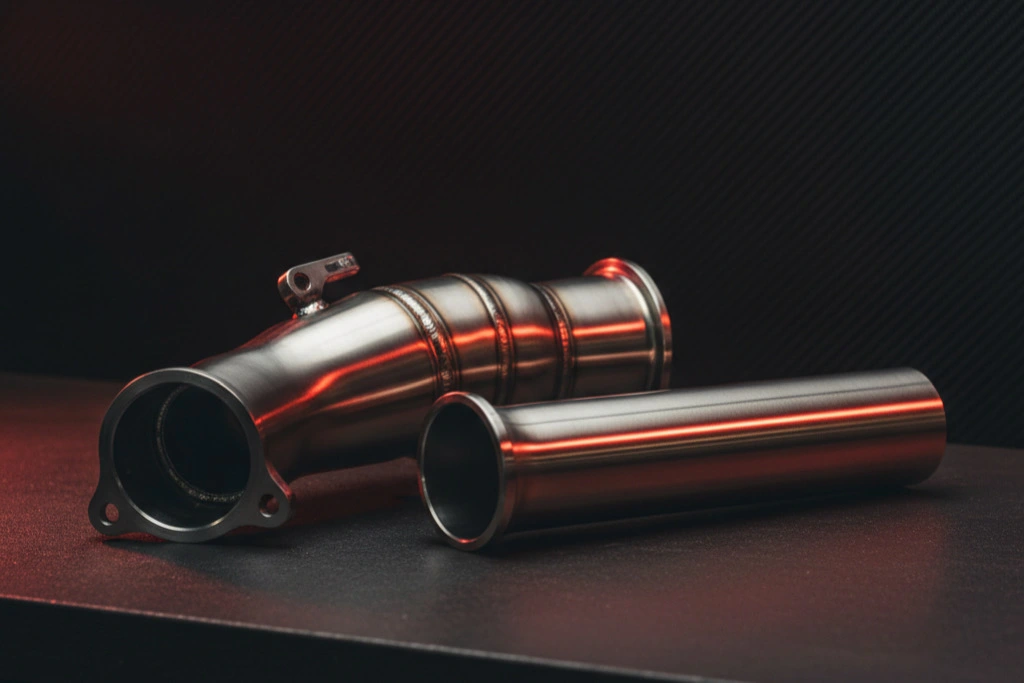
UK Downpipe Laws Explained: Decat vs Sports Cat.
Downpipes are one of the most searched performance upgrades in the UK — but they are also one of the most misunderstood. This guide explains what UK drivers need to know about decat pipes, sports cats, MOT checks, emissions, noise, insurance and how to choose the right setup for a road-focused performance build.
Are downpipes road legal in the UK?
Decat downpipe
A decat removes the catalytic converter from the exhaust system. On a road car that was originally fitted with a catalyst, this creates major MOT, emissions and road-use issues. A decat should be treated as a track-only or off-road specification.
Sports cat downpipe
A sports cat keeps a catalytic converter in the system while improving flow compared with a restrictive factory setup. It is the more suitable route for UK drivers who want performance gains while keeping a catalyst present.
MOT compliance is not automatic
A sports cat still needs to be correctly specified, professionally installed and capable of passing the relevant emissions test. The vehicle must also avoid excessive noise, leaks and obvious emissions-control defects.
If the car was built with a catalytic converter for road use, removing it is not a responsible road setup. For UK road drivers, the correct conversation should usually be about a high-quality sports cat, correct fitment, emissions performance and insurance disclosure — not a decat.
What is a downpipe and why do performance drivers upgrade it?
A downpipe is the section of exhaust that sits close to the turbocharger and carries exhaust gases away from the turbine housing. On many turbocharged performance cars, the factory downpipe is designed around emissions, refinement, packaging, heat management and mass-production requirements. That can make it restrictive when the car is tuned.
Upgrading the downpipe can improve exhaust gas flow, reduce back pressure, sharpen turbo response and unlock stronger performance when combined with the right software calibration. It can also change the exhaust character, making the vehicle sound deeper, sharper and more responsive under load.
The problem is that the downpipe often contains or connects directly to the catalytic converter. That means a downpipe upgrade is not just a sound or power upgrade — it is also an emissions-control modification. This is why UK road legality matters.
Is a decat downpipe legal on UK roads?
For a modern road car that was originally fitted with a catalytic converter, a decat downpipe is not the correct choice for UK road use. A decat removes the catalyst, which is a core emissions-control component. Even if the car appears to drive normally, the vehicle can fail MOT inspection because the catalyst is missing where it should be present.
A decat can also increase exhaust smell, increase noise, trigger engine-management warnings, create emissions-test problems and put the owner in a difficult position with insurance. Some drivers focus only on power gains, but the legal and ownership risk is far more important for a road car.
That does not mean decat pipes have no place at all. They can be used in controlled motorsport, off-road or track-only environments where road regulations do not apply in the same way. But for a daily-driven or road-registered UK vehicle, a decat should not be sold or presented as a road-compliant solution.
Are sports cats road legal in the UK?
A sports cat is the more sensible route for UK road-focused performance builds because it retains a catalytic converter while improving exhaust flow. Instead of completely removing the catalyst, a sports cat uses a freer-flowing catalytic core, often described by cell count, such as 200-cell.
The key detail is that a sports cat is not automatically guaranteed to pass MOT or meet every legal requirement simply because it contains a catalyst. The result depends on the vehicle, catalyst quality, engine condition, tune, warm-up, sensor setup, installation quality and the emissions limits that apply to that vehicle.
For most UK performance customers, the best direction is a high-quality sports cat combined with professional installation and responsible software calibration. This gives the owner a more balanced setup: stronger flow and sound, without taking the same road-use risk as a decat pipe.
Keeps a catalyst in the system
A sports cat keeps the exhaust system closer to a road-use structure because it does not simply delete the emissions-control component. This matters for MOT inspection and responsible ownership.
Improves flow over restrictive factory parts
A well-designed sports cat downpipe can reduce restriction and support stronger turbo response, especially when paired with appropriate ECU calibration.
Sharper exhaust character
A sports cat can give the vehicle a deeper and more defined exhaust note without moving into the excessive smell and rawness normally associated with decat setups.
More suitable for daily-driven builds
For cars used on public roads, a sports cat is usually the cleaner, more responsible and more saleable option compared with a decat pipe.
What can make a downpipe setup fail MOT?
The MOT is not just a simple visual glance at the exhaust. The vehicle can be checked for exhaust security, serious leaks, excessive noise, emissions output and visible emissions-control equipment. That means the quality of the part, the installation and the chosen specification all matter.
| Issue | Why it matters | Road-focused approach |
|---|---|---|
| Missing catalyst | If the vehicle was originally fitted with a catalytic converter, a missing catalyst creates a major MOT and road-use concern. | Choose a correctly specified sports cat, not a decat, for a road-driven vehicle. |
| Emissions failure | The car must meet the required emissions limits for its age, fuel type and category. Poor catalyst quality or incorrect tuning can cause failure. | Use a quality catalyst, correct mapping and ensure the vehicle is fully warmed before testing. |
| Excessive noise | A downpipe can increase volume. If the vehicle is considered too noisy, it can create MOT and road-use issues. | Balance downpipe choice with resonators, rear exhaust design and daily-road usability. |
| Exhaust leaks | Leaks can affect emissions readings, noise and overall roadworthiness. | Use professional installation, correct gaskets, correct clamps and proper post-install inspection. |
| Warning lights | Sensor issues, catalyst efficiency faults or poor calibration can trigger engine-management lights. | Use a setup designed for the platform and confirm software compatibility before fitting. |
Which downpipe should you choose for a UK road car?
If your car is road-registered and used on UK public roads, the stronger buying decision is usually a high-quality sports cat downpipe. It gives you the performance direction most owners actually want — better flow, stronger sound and improved response — while keeping the vehicle more aligned with road-use expectations.
A decat can sound tempting because it is often cheaper and less restrictive, but that low-friction decision can become expensive later. MOT problems, emissions issues, insurance complications, unpleasant smell and unwanted attention can make the car harder to live with and harder to sell.
This is why ASM Sports Tech positions the sports cat as the more complete ownership choice for road-focused builds. It is not just about maximum noise or headline power. It is about building a vehicle that performs, sounds right and remains usable.
The responsible performance route: sports cat, correct fitment, correct calibration.
The best performance builds are not the loudest. They are the ones that feel complete. A downpipe should support the engine, the tune, the exhaust system and the way the car is actually used. For a UK road car, that means choosing a setup that respects emissions equipment, avoids excessive noise and remains suitable for daily driving.
Before ordering a downpipe, always think in systems: turbo, catalyst, sensors, ECU calibration, MOT emissions, exhaust layout, heat management and insurance. A cheap decat pipe might solve one problem — restriction — while creating several more. A properly specified sports cat is a more refined decision.
Confirm the vehicle
Engine code, year, drivetrain, trim and current exhaust setup must be checked before choosing a downpipe.
Choose road or track
If the car is used on UK roads, build around a sports cat. Decat should be treated as track-only.
Plan the software
A downpipe can require calibration to manage performance, sensors, boost control and drivability properly.
Declare the change
Performance exhaust modifications should be disclosed to insurance providers to avoid future complications.
For a UK road car, the most intelligent downpipe choice is not the most aggressive one. It is the one that delivers performance while keeping the build usable, responsible and properly specified.
ASM Sports Tech — Road-focused performance guidanceWhy decat can make a road car worse to live with.
Many buyers initially focus on power and sound, but daily usability matters just as much. A decat can create a raw exhaust smell, more cabin drone, harsher cold-start behaviour and a much louder tone than expected. On some cars, it can also make the vehicle feel less refined even if it performs well under full load.
A sports cat usually gives a cleaner balance. The car can still sound stronger and feel more responsive, but the catalyst helps keep the setup more controlled. For modern performance vehicles, this is often the difference between a car that feels carefully developed and a car that feels unfinished.
If the car is a weekend-only track build, the decision may be different. But if it is used on public roads, photographed for business, driven to clients, sold through a dealer, or enjoyed as a high-value personal car, a road-focused sports cat is the more complete ownership decision.
UK Downpipe Law FAQs
Are decat downpipes legal in the UK?
For a road car that was originally fitted with a catalytic converter, a decat is not a suitable UK road-use setup. It removes emissions-control equipment and can create MOT, emissions, insurance and road-use problems. Decat pipes should be treated as track-only or off-road specifications.
Will a decat fail MOT?
A vehicle can fail MOT if a catalytic converter is missing where one was fitted as standard, or if emissions-control equipment is missing, obviously modified or defective. A decat also creates a high risk of emissions-test failure.
Are sports cats legal in the UK?
A sports cat is generally the more road-focused option because it retains a catalytic converter. However, it must still be correctly specified, properly installed and capable of passing the relevant emissions test for the vehicle. Road legality is not guaranteed simply because the part is called a sports cat.
What is better for a UK daily driver: decat or sports cat?
For a UK daily driver, a sports cat is usually the better choice. It offers improved flow and sound while keeping a catalyst in the system. A decat is more aggressive but brings much higher legal, MOT, smell, noise and insurance risk.
Do I need to tell my insurance about a downpipe?
Yes. A downpipe is a performance exhaust modification and should be declared to your insurer. Failing to disclose modifications can create serious problems if you later need to make a claim.
Can a sports cat still fail emissions?
Yes. A sports cat can still fail emissions if the catalyst quality is poor, the car is not warmed correctly, the tune is unsuitable, the engine has existing issues, or the catalyst is not appropriate for the vehicle’s emissions requirements.
Does a downpipe need a remap?
On many turbocharged vehicles, a downpipe upgrade should be paired with suitable ECU calibration. This helps manage performance, boost control, sensor behaviour, drivability and engine safety. The exact requirement depends on the vehicle and part.
Choose the right downpipe before you choose the loudest one.
ASM Sports Tech can help you choose the correct sports cat or performance downpipe direction for your vehicle, based on platform, power goals, road use, sound preference and ownership expectations.